How ChatGPT Became My Personal Fitness Coach (Without Replacing My Doctor or Trainer)

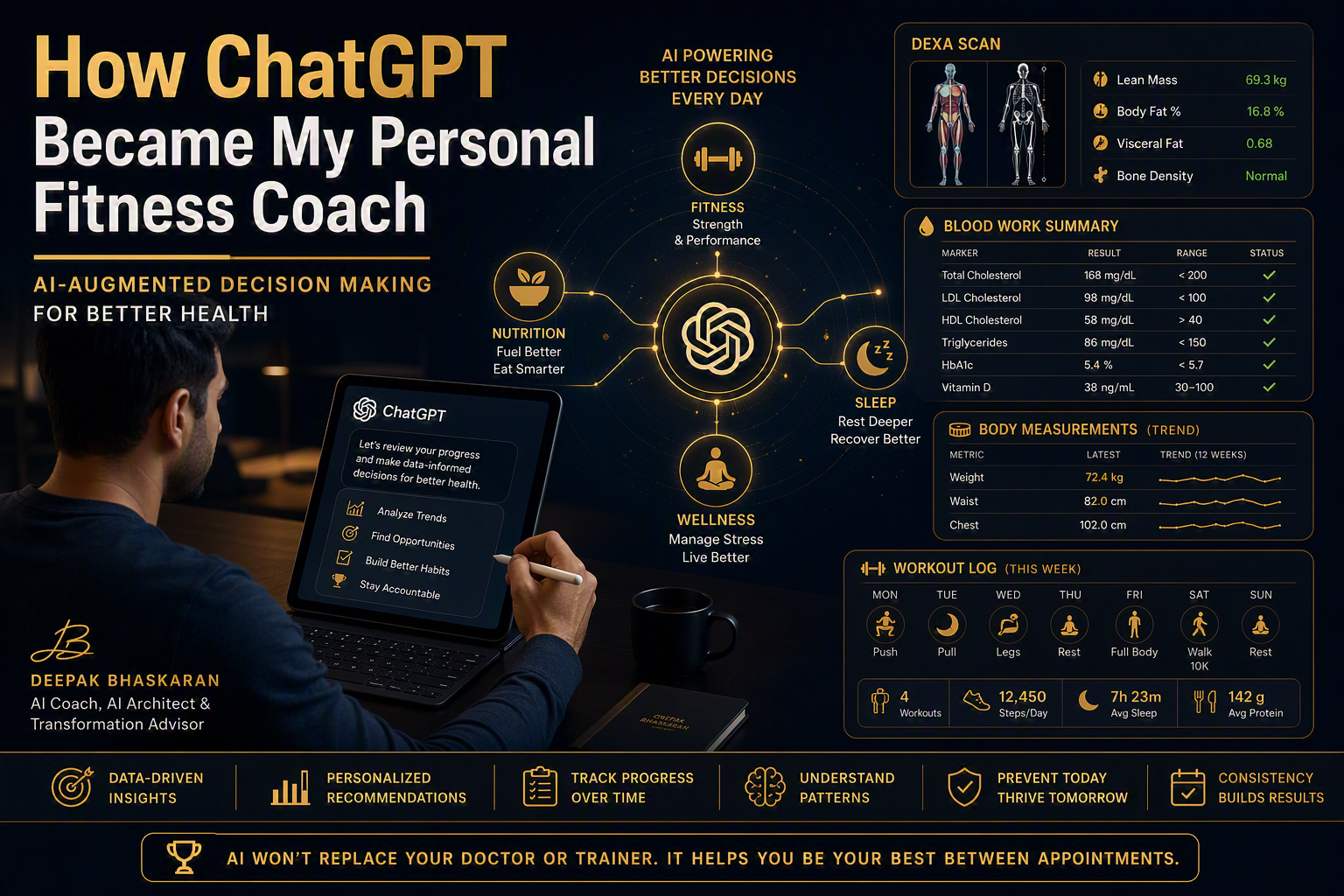
Why Generative AI May Be the Most Underrated Health Companion You’ll Ever Have
Over the past year, I’ve been exploring how Generative AI can improve everyday decision-making—not just at work, but across many aspects of life.
It has helped me:
- Optimize my personal finances and identify more than $20,000 in long-term savings opportunities.
- Navigate the complexities of a hit-and-run insurance claim.
- Design and maintain my backyard landscaping.
- Build a personal AI operating system for content creation and productivity.
Naturally, the next question I asked was:
Can ChatGPT help me become healthier?
Not by replacing my doctor.
Not by replacing a personal trainer.
And certainly not by prescribing miracle diets.
Instead, by acting as a thinking partner—helping me stay organized, identify patterns, ask better questions, and remain accountable to the goals I had already set.
After several months of experimentation, I’ve come to appreciate ChatGPT as one of the most useful fitness companions I’ve ever had.
Not because it knows everything.
But because it helps me think more clearly and stay consistent.
Before You Start: A Few Important Guardrails
As with any health-related use of AI, it’s important to use ChatGPT responsibly.
Never Share Sensitive Personal Information
Avoid uploading documents containing:
- Government-issued IDs
- Insurance information
- Medical record numbers
- Home addresses
- Financial information
- Personally identifiable information (PII)
If you upload health reports, redact personal identifiers whenever possible.
Trust, But Verify
ChatGPT can explain concepts, summarize reports, and organize information.
It cannot:
- Diagnose illnesses
- Prescribe medication
- Replace your physician
- Provide emergency medical advice
Think of ChatGPT as an informed companion—not a licensed healthcare provider.
Build Your Own Health Philosophy First
One of the biggest mistakes people make is asking:
“What should I do?”
before deciding:
“What do I actually believe?”
AI is incredibly good at helping you execute a strategy.
It is much less useful if your strategy changes every week because of the latest social media trend.
Before using ChatGPT extensively, spend time learning from evidence-based sources.
Books that have shaped my own thinking include:
- Outlive – Dr. Peter Attia
- Why We Sleep – Dr. Matthew Walker
- Atomic Habits – James Clear
- The Comfort Crisis – Michael Easter
- Burn – Herman Pontzer
These resources helped me develop my own Personal Health Operating Model, including principles such as:
- Prioritize long-term health over short-term weight loss.
- Strength train consistently.
- Walk daily.
- Prioritize sleep and recovery.
- Measure progress across multiple indicators—not just the scale.
Once those principles were clear, ChatGPT became far more valuable because it helped me execute my system rather than constantly replacing it.
Think of ChatGPT as a Decision Support Companion
Many people think of ChatGPT as a calorie counter.
That’s like buying a smartphone and only using the calculator.
Instead, I think of it as three complementary roles working together.
Fitness Coach
Helping me:
- Build workout routines
- Track progress
- Suggest progressive improvements
- Maintain accountability
Nutrition Coach
Helping me:
- Review meals
- Increase protein intake
- Optimize grocery shopping
- Make better restaurant choices
AI Thinking Partner
Helping me:
- Identify trends
- Connect information over time
- Explain complex concepts
- Recommend small, high-impact improvements
The real value isn’t having all the answers.
It’s helping me ask better questions.
Create your Health Baseline
One of the biggest improvements I made was giving ChatGPT enough context to understand me.
Instead of asking generic questions, I built a structured Health Baseline that allows ChatGPT to provide more personalized, relevant, and consistent recommendations over time.
Importantly, I did this without sharing any personally identifiable information (PII).
Here’s what I included.
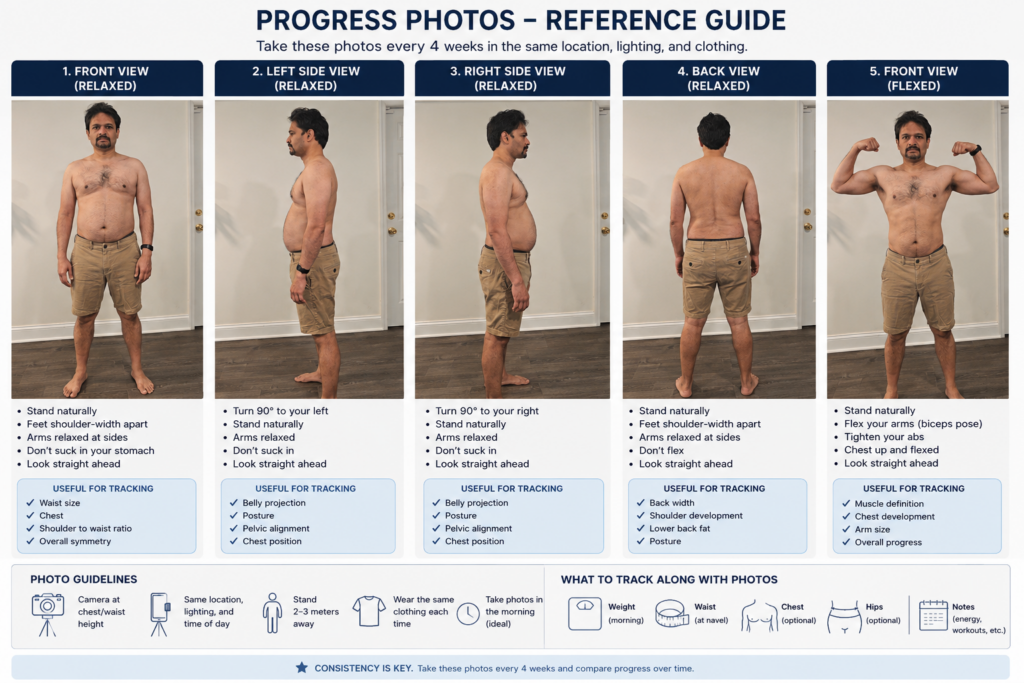
Profile Images
I uploaded front, side, and back photos taken under consistent lighting and conditions.
These are not used for body fat estimation, but for tracking visual progress over time.
Prompt you can use:
Act as an evidence-based fitness coach. Compare these progress photos with my previous baseline. Focus on posture, muscle definition, waist changes, and overall body composition. Avoid estimating body fat percentage. Highlight improvements, areas that appear unchanged, and recommend one or two priorities for the next month.
Body Measurements
I track measurements weekly using a consistent method:
- Weight – Morning, after using the bathroom, before eating
- Waist – At the level of the navel, relaxed
- Chest (optional)
- Hips (optional)
These trends are often more meaningful than daily weight fluctuations.
Prompt you can use:
Here are my weekly body measurements for the past three months. Identify trends, calculate average weekly changes, highlight periods of progress or stagnation, and recommend one improvement that would have the greatest long-term impact.
DEXA Scan
DEXA scans provide a detailed view of body composition, including:
- Lean muscle mass
- Body fat percentage
- Visceral fat
- Bone density
This adds a level of precision that the scale alone cannot provide.
Prompt you can use:
Review my DEXA scan and explain the results in plain English. Identify the three most important areas I should focus on over the next six months. Compare my results with healthy ranges for someone of my age and gender, and suggest questions I should discuss with my physician or trainer.
Blood Reports
I uploaded recent blood work (with personal identifiers removed), including:
- Cholesterol profile
- Blood glucose / HbA1c
- Vitamin levels
- Liver and kidney function
This helps ChatGPT explain trends and highlight areas worth discussing with a doctor.
Prompt you can use:
Explain these blood test results in plain English. Highlight values that are outside the normal range, explain what they typically indicate, and suggest questions I should discuss with my healthcare provider. Do not diagnose or recommend medications.
Demographic Information
I provided high-level context such as:
- Age range
- Height
- Activity level
- Ethnicity (e.g., Asian)
- Fitness goals
This helps tailor recommendations more appropriately.
Prompt you can use:
Act as an evidence-based wellness coach. Based on my age, height, activity level, and health goals, recommend realistic lifestyle improvements that I can sustain over the next six months.
Family History
I included hereditary risk factors such as:
- Diabetes
- Cardiovascular disease
- High cholesterol
This helps prioritize preventive habits.
Prompt you can use:
Based on my family history of cardiovascular disease and diabetes, along with my current health metrics, identify preventive lifestyle habits that have the strongest evidence for reducing long-term risk. Focus on exercise, nutrition, sleep, and stress management rather than medical treatment.
Genetic Reports (Optional)
If available, genetic insights can provide additional context around:
- Nutritional tendencies
- Recovery patterns
- Caffeine metabolism
These should always be interpreted cautiously.
Prompt you can use:
Review these genetic health insights and explain them in plain English. Identify which findings have strong scientific evidence, which should be interpreted cautiously, and how they may influence exercise, nutrition, or recovery strategies.
Other Medical or Fitness Reports (Optional)
Depending on your situation, you can also include:
- Sleep reports
- VO₂ Max data
- Wearable device summaries
- Physiotherapy assessments
These help connect the dots across different aspects of health.
Prompt you can use:
Review these health reports together with my existing fitness baseline. Identify recurring themes, explain how the findings relate to one another, and recommend the highest-impact lifestyle changes I should prioritize over the next three months.
Why This Baseline Matters
Once this baseline is established, every future interaction becomes more personalized.
Instead of generic advice, ChatGPT begins to understand:
- Your goals
- Your progress
- Your constraints
- Your risk factors
This transforms it from a simple Q&A tool into a long-term health companion.
My Personal AI Health Operating System
Rather than using ChatGPT for isolated questions, I treat it as an ongoing health companion.
Daily
- Track meals
- Review protein intake
- Log workouts
- Record steps
- Capture sleep
Weekly
- Summarize progress
- Review consistency
- Identify habits that slipped
- Suggest one improvement for the following week
Monthly
- Generate an executive health summary
- Review weight trends
- Compare waist measurements
- Evaluate body composition progress
Quarterly
- Review blood work
- Analyze DEXA scans
- Revisit long-term health goals
By keeping everything in a single conversation—or better yet, a ChatGPT Project—ChatGPT builds context over time and provides increasingly personalized guidance.
Practical Ways I Use ChatGPT for Fitness
Nutrition Optimization
ChatGPT helps me:
- Review meals
- Suggest higher-protein alternatives
- Compare restaurant menus
- Plan grocery shopping
- Build sustainable meal plans
Rather than completely changing my diet, I ask:
“How can I improve today’s meals while keeping calories roughly the same?”
Small adjustments are easier to sustain than dramatic changes.
Workout Planning
I use ChatGPT to:
- Design strength routines
- Build progressive training plans
- Review exercise videos
- Suggest mobility work
- Track improvements
The emphasis is always on consistency rather than perfection.
Health Monitoring
ChatGPT can help explain:
- Blood work
- DEXA scans
- Body composition reports
- Wearable device trends
- Sleep patterns
Again, not to diagnose—but to better understand the information before discussing it with a healthcare professional.
Accountability and Reflection
Perhaps the most valuable feature is accountability.
At the end of each month, I ask ChatGPT:
“Summarize my fitness progress this month. Highlight what’s improving, where I’m inconsistent, and recommend the one change that would have the greatest impact next month.”
That single conversation often reveals patterns I would have otherwise overlooked.
Beyond Fitness: Building an AI Wellness Companion
Health is much more than workouts and calories.
ChatGPT also helps me think about:
- Sleep quality
- Recovery
- Travel nutrition
- Stress management
- Hydration
- Habit formation
- Long-term sustainability
Rather than optimizing every detail, I focus on reducing friction and making healthier decisions more consistently.
Common Misconceptions About AI and Fitness
“AI Knows the Right Answer”
No.
AI synthesizes information.
It can make mistakes.
Always validate important health information with qualified professionals.
“Calories Are All That Matter”
Calories matter.
So do:
- Sleep
- Strength
- Recovery
- Protein intake
- Mobility
- Consistency
“More Exercise Is Better”
Recovery is part of training.
Progress comes from balancing effort with recovery.
“Weight Is the Only Metric”
Health is multidimensional.
I pay attention to:
- Waist circumference
- Strength
- Energy levels
- Sleep quality
- Body composition
- Consistency
Those trends tell a much richer story than the scale alone.
Final Thoughts
The future of AI isn’t simply about productivity.
It’s about making better decisions.
For me, ChatGPT has become:
- A fitness journal
- A nutrition assistant
- A habit coach
- A progress tracker
- A wellness companion
Not because it replaces professionals.
But because it helps me engage with them—and with my own goals—from a position of greater understanding and consistency.
And that may be one of the most valuable applications of Generative AI in our everyday lives.