How GenAI Helped Me Save $20,000 This Year | AI for Personal Finance

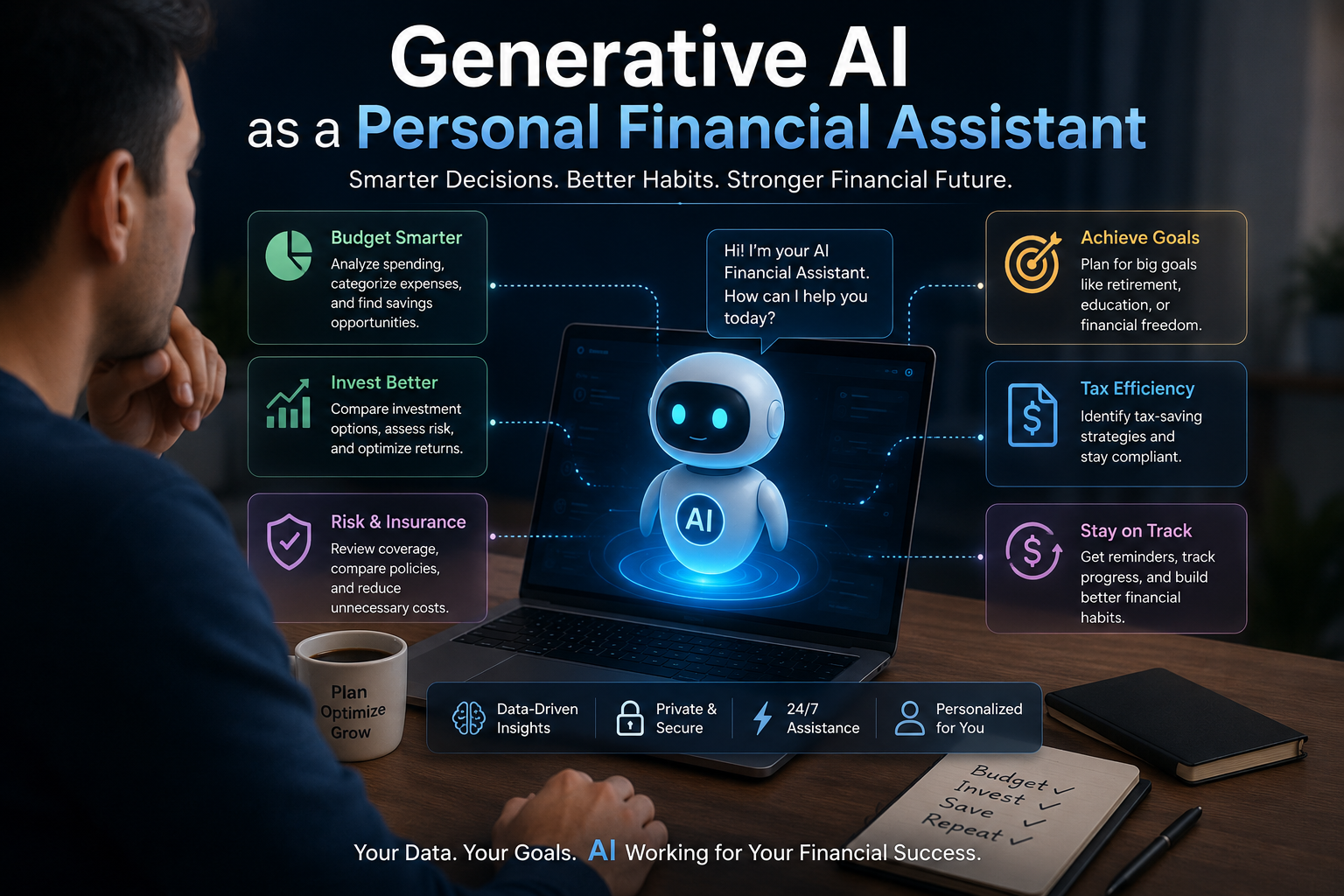
Turning Generative AI into a Personal Financial Advisor, Optimization Coach, and Decision Framework
Introduction
Generative AI for personal finance is quickly becoming one of the most practical and transformational real-world applications of AI. As an Enterprise Generative AI Coach and Architect, I started experimenting with how Generative AI could optimize not only enterprise systems, but also my own personal financial systems.
Over the past year, I used GenAI to analyze spending patterns, optimize cashback strategies, evaluate insurance options, improve investment decisions, and automate financial workflows. The result was over $20,000 in estimated financial impact and long-term optimization opportunities.
In this article, I’ll walk through the exact frameworks, categories, lessons, and best practices I used to leverage Generative AI for personal finance responsibly and effectively.
Disclaimer: Use Generative AI Responsibly
Before diving into how I used Generative AI (GenAI) to optimize my personal finances, it is important to establish a few foundational principles.
Generative AI can become an incredibly powerful financial assistant — but it should never become an unquestioned authority.
1. Never Share Sensitive Personal Information
Avoid uploading or sharing:
- Social Security Numbers
- Bank account numbers
- Passwords
- Tax IDs
- Insurance policy identifiers
- Full addresses
- Unredacted financial statements
You can still receive high-quality guidance by sharing:
- Approximate balances
- Spending categories
- Redacted screenshots
- General spending behavior
- Investment allocations
- Insurance structures
2. Trust, But Verify
GenAI is excellent at:
- Pattern recognition
- Financial optimization
- Scenario modeling
- Comparative analysis
- Opportunity-cost analysis
But it can also:
- Hallucinate
- Miss recent regulation changes
- Oversimplify edge cases
- Lack fiduciary responsibility
Always:
- Validate calculations
- Cross-check insurance decisions
- Verify tax implications
- Review investment assumptions
- Confirm recommendations with professionals when needed
3. Context Determines Output Quality
The more structured your data is, the more personalized and valuable the recommendations become.
Examples:
- Consolidated transaction histories
- Insurance declarations
- Mortgage details
- Recurring subscriptions
- Investment allocations
- Cash-flow patterns
The quality of the questions dramatically improves the quality of the answers.
The Big Realization
As someone who spends most of my professional life helping enterprises adopt Generative AI, I had a realization:
If GenAI can optimize billion-dollar enterprises, why can’t it optimize my personal financial systems?
That question changed how I approached personal finance.
Instead of asking generic questions like:
“What’s the best credit card?”
…I started asking:
“Given my exact spending patterns, insurance setup, mortgage structure, family goals, subscriptions, risk profile, and investment horizon — what is the financially optimal decision?”
That shift transformed GenAI from a chatbot into a personal financial operating system.
Estimated Financial Impact
| Category | Estimated Savings / Financial Impact |
|---|---|
| Transaction & Spending Optimization | $3,000–$7,000 |
| Cashback & Credit Card Optimization | $1,000–$2,000 |
| Insurance Optimization | $500–$2,500 |
| Mortgage vs Investing Decisions | $10,000+ long-term annualized impact |
| Investment Allocation Improvements | Significant compounding gains |
| Behavioral Spending Improvements | $2,000–$5,000 |
| Cash & HYSA Optimization | $3,000–$4,000 |
| Tax & Automation Improvements | $1,000–$2,000 |
1. Financial Optimization Through Transaction Intelligence
What I Did
I uploaded and analyzed:
- Consolidated credit card transactions
- Recurring charges
- Spending categories
- Subscription data
- Cashback card information
- Monthly cash-flow patterns
GenAI helped identify:
- Spending leaks
- Duplicate subscriptions
- Cashback inefficiencies
- Underutilized cards
- Poor recurring payment routing
- Overspending trends hidden inside “Other” categories
Biggest Discovery
One of the biggest realizations was that “Other” spending categories were hiding major optimization opportunities.
Once transactions were properly categorized into:
- Insurance
- Utilities
- Education
- Dining
- Shopping
- Home services
- Transportation
- Entertainment
…the optimization opportunities became obvious.
Estimated Savings
~$3,000–$7,000 annually
Mostly through:
- Reducing unnecessary recurring spend
- Increasing visibility
- Better categorization
- Smarter behavioral decisions
2. Cashback Optimization Using AI
This became one of the most practical and immediately useful GenAI use cases.
Instead of asking:
“What’s the best cashback card?”
…I asked:
“Given my exact spending profile, which of my existing cards should be used for GEICO, Grubhub, Amazon, ChatGPT subscriptions, dining, travel, AMC, Costco, and utilities?”
GenAI Helped Optimize
- Cashback percentages
- Reward category alignment
- Point redemption value
- Opportunity cost
- Recurring payment routing
Example Optimizations
| Expense | Recommended Card |
|---|---|
| Grubhub | Capital One Savor |
| GEICO | Citi Double Cash |
| EZ-Pass | Chase Sapphire |
| Amazon | Chase Amazon Prime |
| Dining | Chase Sapphire / Savor |
| Streaming | Savor |
| Utilities | Double Cash |
Estimated Savings
~$1,000–$2,000 annually
Mostly through eliminating “1% mistakes” across recurring transactions.
3. Insurance Review Using GenAI
This was one of the most eye-opening experiences.
What I Uploaded
- Auto insurance declarations
- Home insurance details
- Coverage structures
- Competitive quotes
- Deductible comparisons
GenAI Helped Me Understand
- NJ insurance structures
- Tort protection
- PIP coverage
- UM/UIM tradeoffs
- Liability balancing
- Umbrella policy timing
- Risk-adjusted protection
The Biggest Insight
The goal is not:
“How do I get the cheapest insurance?”
The goal is:
“How do I optimize risk-adjusted protection?”
That distinction matters enormously.
Estimated Savings
~$500–$2,500 annually
Through:
- Better deductible alignment
- Avoiding over-insurance
- Smarter liability structuring
- Better market comparisons
4. Mortgage vs Investing — The Highest Value Conversation
This single GenAI discussion may have produced the largest long-term financial impact.
Situation
- 30-year fixed mortgage
- 2.75% interest rate
- ~$560K remaining balance
Emotionally, paying off debt faster feels responsible.
But GenAI helped frame the question mathematically.
AI-Guided Insight
A 2.75% mortgage is extremely cheap capital.
Instead of aggressively prepaying the mortgage:
- Continue normal payments
- Redirect surplus cash into:
- Index funds
- Retirement accounts
- Long-term compounding assets
Why This Matters
Historically:
- Mortgage cost: ~2.75%
- Long-term market returns: ~7–10%
That spread compounds dramatically over time.
Estimated Long-Term Impact
Potentially hundreds of thousands over decades.
Estimated annualized long-term advantage:
$10,000+ equivalent long-term value
5. Investment Allocation Optimization
GenAI also became a useful decision framework for:
- ETF overlap analysis
- Index fund comparisons
- Recurring investment strategies
- Concentration risk evaluation
- Alphabet Class A vs Class C analysis
- Portfolio simplification
Biggest Lesson
GenAI was less useful as a “stock picker” and more useful as:
- A rational decision framework
- A behavioral coach
- An allocation optimizer
- A compounding advisor
Additional Improvements
- Consolidated overlapping ETFs
- Simplified investment strategy
- Reduced unnecessary transaction complexity
- Evaluated tax-loss harvesting opportunities
6. Cash Optimization Through HYSA Strategy
One of the simplest but highest ROI improvements.
Problem
Too much idle cash sitting in low-yield checking accounts.
GenAI Recommendations
- Maintain operational cash only in checking
- Move excess liquidity into High Yield Savings Accounts
- Consolidate redundant bank accounts
Estimated Savings
~$3,000–$4,000 annually
Simply by earning 4–5% on idle capital.
7. Behavioral Finance — The Hidden ROI of GenAI
This was perhaps the most unexpected insight.
The biggest savings did not always come from:
- cashback optimization
- insurance reductions
- investment decisions
They came from:
Awareness.
Once financial systems became visible:
- Spending naturally declined
- Friction purchases reduced
- Delivery usage became intentional
- Subscription renewals became conscious decisions
- Emotional spending decreased
GenAI became less of a financial calculator and more of a behavioral mirror.
Best Practices for Using GenAI as a Financial Assistant
1. Consolidate Your Conversations
This is one of the most powerful long-term techniques.
At the end of each year:
Export or summarize:
- Insurance discussions
- Investment analyses
- Spending reviews
- Optimization ideas
- Financial goals
- Lessons learned
Then next year start with:
“Based on last year’s financial optimization discussions…”
This dramatically improves continuity and personalization.
2. Build Reusable Financial Prompts
Examples:
- “Act as my financial advisor and optimization coach…”
- “Analyze these transactions for optimization opportunities…”
- “Compare these insurance structures apples-to-apples…”
- “Given my goals, what is the financially optimal allocation?”
3. Use AI for Decisions, Not Just Answers
The real power of GenAI is:
- Tradeoff analysis
- Scenario comparison
- Opportunity-cost evaluation
- Risk modeling
- Long-term thinking
4. Give Context, Not Generic Questions
Bad:
“What’s the best credit card?”
Better:
“Given my family structure, recurring expenses, travel habits, and existing cards, how should I optimize recurring payment routing?”
Context transforms outputs.
5. Think of GenAI as a Financial Operating System
Not just a chatbot.
Use it to:
- Organize
- Compare
- Forecast
- Simulate
- Rationalize
- Review
- Optimize
Other High-Value Personal Finance Use Cases for GenAI
Budget Planning
- Monthly allocation planning
- Vacation budgeting
- Education planning
- Emergency fund design
Tax Preparation Readiness
- Expense categorization
- Donation tracking
- Business expense analysis
- Estimated tax planning
Insurance Audits
- Policy comparison
- Deductible optimization
- Umbrella policy timing
- Liability balancing
Retirement Planning
- Contribution simulations
- Withdrawal modeling
- Sequence-of-return risk discussions
Large Purchase Analysis
Examples:
- Solar ROI
- HVAC replacement
- Vehicle purchases
- Home renovation economics
Final Thoughts
Generative AI did not magically “make me rich.”
What it did do was:
- Increase visibility
- Reduce inefficiency
- Improve decision quality
- Eliminate emotional financial reactions
- Accelerate analysis and research
- Create systems-level thinking
The most important transformation was this:
I stopped making isolated financial decisions and started making system-level financial decisions.
That is where the real leverage exists.
And that is where Generative AI becomes transformational.
Closing Thought
If you are a professional, architect, consultant, engineer, or knowledge worker:
GenAI may already be the most underutilized personal financial assistant you have access to.
Use it thoughtfully.
Use it responsibly.
And most importantly — use it systematically.