How ChatGPT Helped Me Navigate a Hit-and-Run Accident

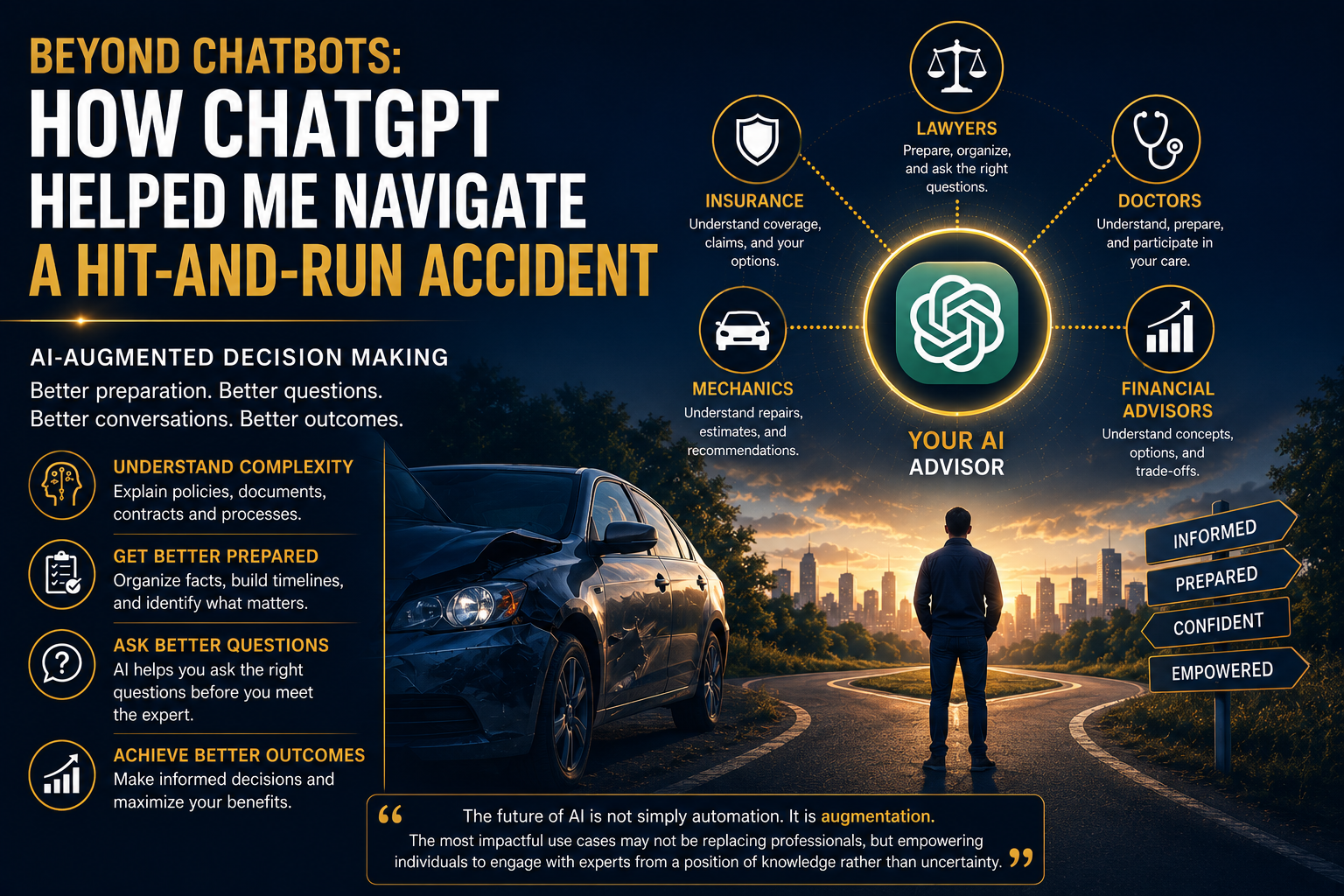
GenAI for real life : beyond Coding and Content Creation
When most executives think about Generative AI, they think about productivity, coding assistants, content generation, or customer service automation.
What is often overlooked is how AI can act as a trusted advisor during unfamiliar, stressful, and high-stakes situations.
Recently, I experienced this firsthand after being involved in a hit-and-run accident. What started as a seemingly minor incident became an eye-opening example of how ChatGPT can augment decision-making, help navigate complex processes, and empower consumers to make informed choices.
This article shares that experience and highlights practical ways AI can be used beyond the workplace.
Important Disclaimers
Before diving into the story, it is important to understand how to use AI responsibly.
1. Do Not Share Personally Identifiable Information (PII)
When working with ChatGPT:
Avoid sharing:
- Full names
- Policy numbers
- Driver’s license numbers
- Social Security Numbers
- Banking information
- Claim numbers (unless partially masked)
- Home addresses
Instead, share only the information necessary for analysis.
For example:
✅ Share:
- Coverage limits
- Deductible amounts
- Vehicle make and model
- Estimate details
- Coverage descriptions
❌ Avoid:
- Full policy documents containing personal information
- Names of insured parties
- Account numbers
Treat AI conversations the same way you would treat discussions in a public professional forum.
2. ChatGPT Does Not Replace Professionals
AI is not a substitute for:
- Attorneys
- Insurance adjusters
- Mechanics
- Medical professionals
- Financial advisors
You will still need professionals to:
- Repair your vehicle
- Represent you legally
- Process claims
- Conduct inspections
However, what ChatGPT does exceptionally well is:
- Make processes more transparent
- Explain terminology
- Identify available options
- Help prepare documentation
- Suggest questions to ask
- Review estimates and contracts
- Validate advice being provided
- Help consumers advocate for themselves
Think of it as an intelligent advisor sitting beside you throughout the process.
The Accident
I was involved in a hit-and-run accident. At first glance, the damage appeared minor, there were very few visible marks on the vehicle.
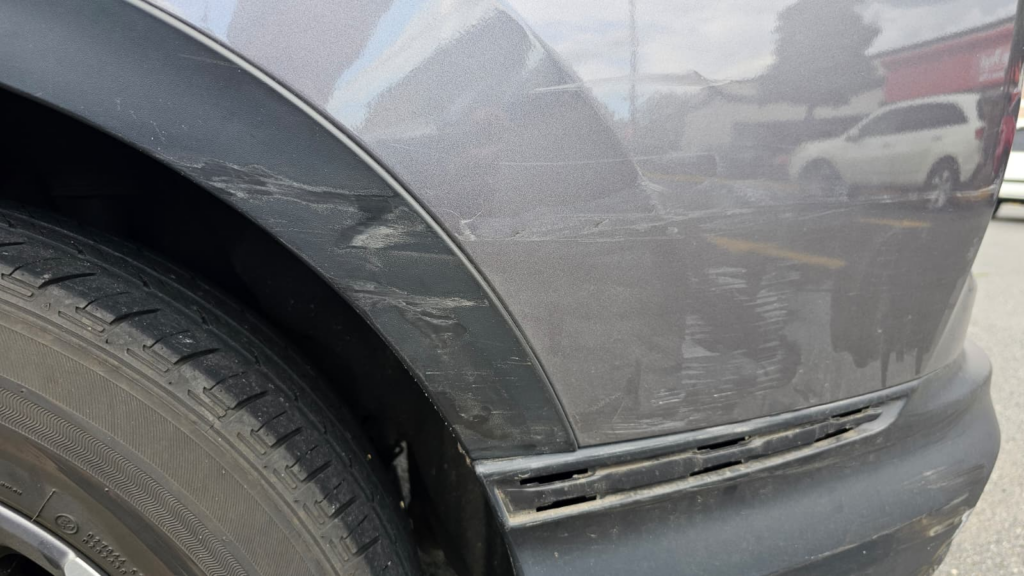
My initial reaction was simple:
“I’ll just get the damage buffed out.”
I obtained an estimate that was approximately $800 just to buff things out and make it look clean from the outside
Many consumers would stop there and I almost did.
Fortunately, I decided to consult ChatGPT before proceeding.
That decision changed the outcome significantly. I saved 2000$ and got everything serviced as new with my insurance coverage and the best part – didn’t affect my PREMIUMS at all !!
What ChatGPT Helped Me Do
1. Determine Whether Insurance Should Be Involved
Initially, I assumed:
- The damage was minor
- Filing a claim would increase premiums
- The process would be more trouble than it was worth
ChatGPT walked me through:
- Collision coverage
- Hit-and-run scenarios
- Uninsured Motorist Property Damage (UMPD)
- Police reporting requirements
- Potential hidden damage
Most importantly, it helped me understand that a hit-and-run claim may be treated differently than an at-fault accident.
This prompted me to investigate further instead of immediately paying out of pocket.
2. Draft a Police Report
After the accident, I needed to document the incident.
ChatGPT helped:
- Structure the timeline
- Describe vehicle movements
- Explain right-of-way
- Capture accident details objectively
- Present facts clearly
This was especially useful because police reports often require concise, factual narratives.
3. Evaluate Insurance Coverage
Insurance policies are notoriously difficult to interpret.
I uploaded screenshots of my policy coverage and estimate documents.
ChatGPT helped explain:
- Collision coverage
- Deductibles
- Rental reimbursement
- Uninsured Motorist Property Damage
- Coverage limits
- Claim processing steps
Instead of relying solely on assumptions, I could ask informed questions of my insurer.
4. Challenge Initial Assumptions with the Autobody shop
The first estimate focused primarily on visible damage.
However, I was experiencing:
- Alignment issues
- Wheel noise
- Potential suspension concerns
ChatGPT encouraged me to ask:
- Was the vehicle road tested?
- Was the wheel bearing inspected?
- Was suspension damage evaluated?
- What caused the humming noise?
These questions shifted the discussion from cosmetic repair to root-cause analysis.
5. Navigate Rental Coverage
When a rental vehicle was provided, ChatGPT reviewed the rental agreement and helped determine:
- Whether GEICO was paying directly
- Whether daily costs were within coverage limits
- What protections had been declined
- How existing insurance might extend to the rental vehicle
Again, this was not legal advice.
It was simply a second set of eyes reviewing a lengthy document.
6. Negotiate More Effectively
One of the biggest benefits was not that ChatGPT gave answers.
It helped me ask better questions.
Examples included:
- Why is this claim being processed under collision rather than UMPD?
- What documentation is required?
- Does accepting payment close the claim?
- Can supplements be submitted later?
- How should hidden damage be documented?
Those questions changed the quality of my conversations with both the insurance company and the repair facility.
The Financial Impact
The most tangible outcome was uncovering a potential path to additional coverage benefits.
Without AI assistance, I likely would have:
- Accepted the first estimate
- Paid out of pocket
- Missed available insurance benefits
Instead, I became aware of coverage options and reimbursement opportunities that may have otherwise gone unnoticed.
In my case, the value of having an informed advisor was worth far more than the cost of the AI subscription itself.
The Real Value: A Trusted Companion
The biggest benefit was not drafting documents.
It was not reviewing estimates.
It was not summarizing insurance language.
The biggest benefit was having a knowledgeable companion throughout a process I had never navigated before.
Every time a new document arrived:
- Police report
- Insurance estimate
- Rental agreement
- Repair recommendation
I had someone available to:
- Explain it
- Analyze it
- Challenge assumptions
- Suggest alternatives
That dramatically reduced stress and uncertainty.
Best Practices for Using ChatGPT in Complex Situations
Keep Everything in a Single Conversation
This is perhaps the most important recommendation.
When handling a complex issue:
- Accident claims
- Home repairs
- Medical billing disputes
- Travel disruptions
- Warranty claims
Keep all information in one conversation.
This allows ChatGPT to:
- Remember context
- Track decisions
- Identify inconsistencies
- Recommend next steps
Consider Creating a ChatGPT Project
For larger situations, create a dedicated ChatGPT Project.
Benefits include:
- Centralized documentation
- Consistent context
- Easier tracking of files and conversations
- Better continuity over time
A project effectively becomes your AI-powered case file.
Upload Supporting Documents
Useful documents include:
- Estimates
- Policies
- Contracts
- Rental agreements
- Invoices
- Emails
The richer the context, the better the guidance.
Ask “What Am I Missing?”
This simple question often produces the greatest value.
Experts know what to ask.
Consumers often do not.
AI helps bridge that gap.
Final Thoughts
We often describe AI as a productivity tool.
That description is too narrow.
Increasingly, AI serves as a personal advisor that helps individuals navigate unfamiliar processes, understand complex documents, and make better decisions.
The goal is not replacing professionals.
The goal is becoming a more informed consumer.
In my case, ChatGPT did not repair my vehicle.
It did not process my claim.
It did not provide legal advice.
What it did do was help me understand my options, ask better questions, challenge assumptions, and navigate a process that would otherwise have been confusing and stressful.
That may ultimately be one of the most valuable applications of AI for everyday people.